Friday, March 20, 2009

Destination Free Web

Where are we headed?

For a variety of reasons the web is changing from a set of interconnected sites to one of almost a free flowing of information. Back in 2007 I wrote a piece for Chief Marketer entitled "What's Still Missing from Web 2.0?" A lot has changed since then, so I thought I'd update some thinking.

The basic premise is that the history of any product or technology will give you clues to its future and trajectory. Using the story from Genesis, the article outlines what happened in each of the last six decades and concludes that the sole purpose of the Internet is to connect different bits of information where they are held. The browser and search succeeded because they assisted in moving people from place to place. It ended with the speculation that the model of moving from place to place was not what people really want. We want to have content served the way we like it. There are simply too many destinations to remember, bookmark of otherwise keep track of. It concluded with the following:
The marketer with a lot of content has a choice – entice people to come to their site which is an ever increasing expense, or relax the assumption about destination and focus on the distribution [of content].

So what's changed?

First, social activities on the Internet have gone from niche to mainstream. In the aggregate these tools account for more activity than email and rank only behind search. It is well established that display advertising fails to effectively redirect people away from where they're comfortable.

Second, technologies are advancing quickly to support the transfer of data as opposed to the maintenance of a connection. Broadband and streaming are becoming mainstream as well.

Driven in a large part by the social media sphere there have been numerous examples of the implications of these changes.
  • Contact forms will move from a site to social profiles as noted on Web Strategist. This also suggests that lead form and landing pages will go the way of the carrier pigeon.
  • Twitter is built on a variety of technical backbones making it nearly completely portable with more than 50% of the activity happening on non-Internet sites. The fact that it doesn't require content to work (like Google) makes it extremely flexible.
  • Web 3.0, semantic web, etc. is loosely defined as finding and consuming the content not the container. Like any food we aren't interested in the wrapper, just the content.
  • The source of information may no longer be known as a 'site' as tools like Apture continue to push the edge of content mixing.
  • Company news is being converted to consumable and findable chunks by the social media news rooms like pitchengine or newscactus.
It seems we are on a trajectory for a 'destination free web'.

Wednesday, March 18, 2009

On the Competition for Social Media Help

How does a community behave commercially?

The "Social Media Club" launched its first question of the week:
How can we best support our social media community and our peers knowing full well we’re often competing for the same clients and client money?
I like to think that co-opetition means that it is in everybody's best interest to move a category forward even if a specific opportunity is competitive. While the term is usually thought of as a means of leveraging cost structures on complex deals, the application to social media at the moment appears to be more of a 'greater good' opportunity.

Three thoughts:
  • Part of the uniqueness of social media by its very nature is it also allows us to build out our network of like minds in order to learn. I can't think of another business-related vehicle that facilitates contact with outsiders as much. In other times and places the only time we could chat with competitors without the risk of being fired was at trade shows. During rapid category growth learning and experiences out-weigh the competitive threat. Only in a fixed or diminishing pie do competitive threats arise.
  • In time we will develop our own competencies, niches and unique solutions as this medium both matures and fragments. For instance I wouldn't attempt to build a private community, a social user group, or counsel CEOs on PR crises. I would (and do) leverage social media as it relates to branding, positioning, and lead generation in specific categories. The challenge will be in recognizing that leaving a nickle on the table is a commercially viable strategy and better for the client in the long run.
  • If we think about a career its really a series of hopefully cool projects; if the paycheck comes from the same source so much the better. So, if we are to pursue our individual passions and interests we need to know who else is doing neat things. The active use of social media in this regard leaves the other options in the dust.
Without interaction we're only as good as our individual thinking.


Some tags: #SMCQ1, #Coopetition

Friday, March 13, 2009

Social Media Footprint

What can brands learn from green?

There should be no doubt anymore that social media has a role in people’s lives. Penetration is beyond the tipping point and every news source talks about it, uses it, or tries to ignore it. We're past the tipping point. The question for marketers is not whether, but how this media impacts them. To try to make sense of amorphous thing called 'social media' this post borrows a concept from the environmental movement to help put it into context.

The interplay between people and the environment is extremely intricate and until green and carbon footprint emerged as concepts there was no mental picture of what ‘environmental impact’ meant. It was simply too complex to think about with lots of variables, assumptions and points of view. While green offers a powerful associated idea, footprints are measurable. Wiki defines them as the “measure of the impact human activities have on the environment in terms of the amount of greenhouse gases produced.” In particular, the measure is metric tons of CO2.

Why does the concept of a ‘footprint’ work? For the very reasons marketers love: it is simple, memorable, and visual. And in the end, there is one number.

Is there a corollary for social media? It is certainly a complex arena with as many points-of-view as there are writers, bloggers, speakers, and CEOs. It also has as many technologies as there are ways to produce CO2 – from social networks to blogs to forums to bookmarking to video. If social media is about people sharing experiences and discussing interests then one can think of a Social Media Footprint in as the impact these activities have on a business. The remaining step is to think about a way to summarize social media that combines the numerous facets that make up influence.

The success of the carbon footprint is that all sources can be reduced to one variable – tons of CO2. This makes it possible to simply sum up all the parts to get the big picture. Add the impact of your house, your car, and your air travel together and you get your footprint. Now it is true that other factors impact global warming, like methane emissions and solar radiation, but the fact remains people, companies, and countries galvanized around the simplicity of this concept.

In social media, the conversation is the thing. Thus, the Social Media Footprint for a brand should focus on capturing the amount of conversation happening along with the presence of the customer base online. Several people have documented the breadth and diversity of social media, e.g. Scoble/Barefoot’s “Starfish” or Solis/Thomas’ “Prism.” Others still have wrestled with the idea of measuring the influence of individual resources. Marketers are thankful for such categorizations but may still wonder how to make it simple to communicate the overall effect.

While the ultimate objective should be financial, it may be easier to first build a common understanding by using simpler measures to start – things like total reach – before moving on to ‘engagement’, ‘influence’, and ROI. This concept isn’t dissimilar to the evolution of broadcast media which started impressions or rating points and then moved to financial measures. It also provides a framework for both documenting assumptions and testing hypotheses: “If we double our social media footprint, we’ll increase sales by x%.”

Some ideas for creating the footprint include:
  • Social Networks: penetration, share of profiles, and breadth of profiles of the brand’s customers compared to that of a benchmark group.
  • Blogs, Micro-blogging and Forums: brand mentions, blog rolls, link activity and or comments
  • Video and Podcasts: share of product or company activity
  • Bookmarking: share of links and tags
Similar to ‘tons of CO2’ the intent of the above approach is to provide an understanding of a brand’s relative rather than absolute position. The Social Media Footprint is a way to compare across brands. It is not meant to be precise since understanding the concept of influence is still very much a work in progress. And just like environmental impact it is unlikely that there will ever be a single metric for measuring social media or the influence of a given source; that’s not how the world works. But hopefully this idea suggests a way to begin thinking strategically about conversation marketing as people talk amongst themselves.

Tuesday, March 10, 2009

The Twitter Paradox

What has twitter done to me?

The answer is somewhat paradoxical: I read more yet less at the same time.

Through links embedded in tweets I have a chance to see far more articles, posts, comments and thoughts than I could ever find on my own. Yet the breadth of sources forces me to change my consumption patterns. I now treat copy just like search results - I scan. Getting to the gist of a post or article is becoming quite critical. And if it isn't evident - I move on.

Gone are the RSS feeds from what had provided value; in its place are the near-time thoughts (recommendations) from people who I am learning to trust. So if @--- says "must read" - I do in a kind of a Pavlovian response. Yet as the number of tweets and retweets of a given item increases I'm wondering why this or that content is important to an individual. What's still missing for me is the answer to that question. It is easy to retweet stuff, I do it. But it needs more context.

Earlier today Brian Solis wrote about blogs potentially losing their influence. I'll skip the definition of what influence might mean in this context. But certainly agree with the implication that behavior is changing. In fact the actual writing of content may change to make it more consumable for micro-blogging. This in turn may reduce the opportunity for deep thinking and digestion.

Is twitter a tapas bar?

Friday, March 06, 2009

Left Brain Marketing and Right Brain Technology

Why did the roles have to switch?

Several years ago I presented to an assembly of marketing services executives on why marketing is difficult to support with the usual set of reporting tools. The title was: "Satisfying Left Brain Marketing with Right Brain Technology." I followed former Forrester analyst Eric Schmitt who had just written about the effect of media fragmentation, consumer trends, and the need for measurement in a paper entitled "Left Brain Marketing." Given the continued focus on accountability, ROI and results I thought I'd dust if off as a post.

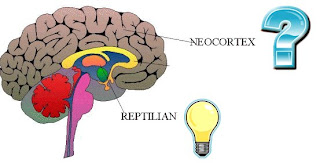
First, let's recap how the brain works. This won't be too detailed - but for the curious see Marian Diamond's biology lecture at Berkeley or read the Brain Atlas: How each area of the brain relates to customer loyalty.

Here's a short list of attributes associated with each side of the brain.

Marketing is often associated with the right side and creativity while analysts are coming out of left field, literally. These perceptions have certainly changed, e.g. not every agency is like Mad Men, but it can still lead to some interesting Venus-Mars discussions. For example, consider the extreme conversation around developing a new customer segmentation scheme.

Marketer: "We need to find new customers."
Analyst: "What requirements do you have?"
Marketer: "I don't know, one that gets us into a new market."
Analyst: "What data to we need to use?"
Marketer: "That which tells me the answer I need."

Five years ago when I first presented this it got a lot of laughs as if hitting a nerve. There's been a lot of progress on closing the gap from both sides. Marketers are much more precise in their requests and analysts better understand ambiguous needs. But let's go back to the basics and why the chasm existed.

Marketing is not creative because it produces ads; it is creative because that's its job - find new markets, grow the business, and satisfy unmet needs. None of those tasks can be easily managed by a spreadsheet or a daily report. In fact, back in '98 CIO wrote about marketing's 'creative mandate' and it was that role that made marketing the last hold out for IT. Why?

Most departments manage to a plan that is only an incremental change from the status quo, e.g. production, operations and even sales. On the other hand marketing is told by the CEO "grow this business," "blow the doors off," "beat the competition," etc.

In short, marketing is paid to change history. They are looking for what they didn't know they needed to know.

Now let's look at the corporate or IT analyst responsible for producing information. The vast majority of management reports look at the business through the rear view mirror. Their sole purpose is to answer the question: Are we on plan to hit our numbers? If not, where are we off so we can take corrective action? Nearly everybody is on board with this approach because their job and compensation is aligned with those numbers. Ever try to stop producing those reports? You'll hear all kinds of reasons for keeping them alive. It turns out that report building is like capital investing: a lot of upfront costs that we hope to amortize over the lifespan of the project. This works great for the 'daily sales report' and other questions that stay the same. In fact, these reports are so stable you can draw an organization chart just by looking at them. Products, markets, and financial periods are easily transferred to job titles.

But marketing threw a monkey wrench into the whole notion of management reporting. Why? Because the half-life of a marketer's question is measured in hours if not minutes. The exploration of new ideas generates a lot of of questions. Some produce produce useful answers but most end up with 'oh, well it was an idea.' The traditional method of producing reports actually trained marketers to NOT ask questions because they couldn't get answers in either a timely or cost effective manner. This learned helplessness created the gap between marketing and technology.

What was needed was a way to drive the marginal cost of a new question to zero. If this could be achieved then marketing could ask all the questions it wanted and not have to wait 6 weeks and spend $1,500 to get a report that would only be used once. Technology and management reporting needed to change and figure a way to make marketers self-reliant. To do this some right-brain thinking had to be applied. The approach was to provide marketers with the ability to ....
  • Follow a train of thought and change their mind without having to go back to the well every time they thought of something different
  • Create new information (data) since we have no idea what interim metrics might prove useful
  • Visualize patterns and relationships since we don't yet understand how to organize any better
So rather than define reports in terms of rows and columns our focus was on understanding what behaviors and transactions mattered to marketing and what attributes might be useful to better understand what people do.

Today, the fire hose that is social media data poses some of the same challenges. How do we harness the vast quantities of raw data to help marketing achieve its objective: align solutions with needs to everyone's benefit?

(Disclosure: at the time this talk was given I worked for a software company focused on solving this problem. Today I work on the agency side trying to understand it all over again.)

Thursday, March 05, 2009

Social Media ROI

What is the value of engagement?

While this is the beginning of the season for Bridal Shows, we're talking about the use of social media and its impact on a business. The Social Media Academy published a piece on defining ROI.

The group defines it as follows using their emphasis:
Contribution Margin in currency generated from externally referred customers
over Interaction Cost in currency for human interaction and other cost to manage and engage in the ecosystem
I'm left with a couple of questions. First, what is 'externally referred customers'? Second, what 'ecosystem' is being considered, and possibly more importantly what isn't considered? The report says both are easily defined; I'm not so sure. We know people will use the channels they want, when they want making attribution an extremely difficult challenge. (See the "TV impacts search" reports.) Without definitions for these concepts the fact that it is based on margin and cost (a very good thing) it falls short.

There are only a few finite outcomes that result in contribution margin.
  1. A non-customer becomes a customer (trial or penetration)
  2. A customer doesn't become a non-customer as soon as we'd expect (repeat rate.)
  3. A customer buys more frequently (purchase cycle).
  4. A customer spends more per transaction (units per).
If social media does a good job of reinforcing #2, #3, & #4 how is that accounted for? Collectively these elements contribute heavily to life time value and that should be as much a focus as acquisition. Brand evangelists reinforce one another, e.g. Fiskateers, so to appear to focus on acquisition only is potentially misleading the impact of conversations.

Update: Just read a good article on measurement that offers a holistic view.

Monday, March 02, 2009

The Nature of Influence

How and why does influence work?

There have been numerous discussions on the use of social media to find and leverage the recommendations of consumers. While the idea has face validity and support ranging from "The Tipping Point" to the "New Influentials" there is still the need to understand how it works. Micah Baldwin had a post today on measuring online influence that talks about influence as being driven by trust. This post offers a potential definition of 'influence.'

To understand influence let's look at a typical conversation pattern. Here's a conversation network map or diagram of the conversations involved in the decision of attending an online high school. As with many decisions there are numerous players and connections.


The parent, the central figure of the decision, has numerous sources of information ranging from:
  • Other parents
  • School district officials, Administrators
  • Students and Teachers
  • Online high school providers
Which ones have influence?

The answer to that question requires establishing the elements of influence, i.e. what factors contribute to a source having a greater contribution than another? The general consensus is that trust and brand recommendation make up influence. In short hand, that would look like:

Influence = f(Trust, Brand Charge)

Now these terms need to be defined in measurable elements. Borrowing from Social Network Analysis and marketing, we can propose the following.

Influence consists of Trust and Brand Charge. A positive recommendation from a trusted resource has substantially more influence than a so-so comment from a casual source.

Trust is built upon Strength and Relevance:
  • Strength of a relationship is based on experience and the willingness to help in the past. Experience in turn can be defined in terms of frequency and longevity of the relationship.
  • Relevance is based on expertise, usability, and bias. Clear, direct, unbiased statements have more relevance.
Given a relationship, the message can be charged: Single, unambiguous and timely recommendations - 'see this movie tonight' - have substantially more influence than vague statements delivered out of the decision making time frame.
  • The number of alternatives affects the intensity of the recommendation.
  • Clearly sentiment plays a role: Positive vs. Negative
  • Timing, or distance from decision, also affects charge.
In sum, Influence can be broken down into a set of nine components that can be the focus of specific activities. If a brand wants to exhibit influence it has to provide useful information over a longer period of time than the typical campaign. Furthermore, the information has to be delivered in a way that improves one or more component of influence as perceived by the recipient. This last point suggests why two-way conversation is much more effective.

Thursday, February 26, 2009

Twitter Meets The Blog

How can we merge micro and major blogging?

Twitter, the now nearly de facto micro-blogging platform is great for what Olivia Mitchell has called twitterbites - a pithy and smart statement that summarizes a point, starts or continues a conversation. On the other hand, blogs are a great platform to develop a thought more fully and allow a collection of comments.

So, we have two excellent ways to converse - one more simultaneous and real time, the other more asynchronous and linear. If there were no link between the two, all would be fine. But tiny URLs create a bridge between the two worlds; spawned by a reader who found the post interesting or the author wanting to publicize the topic.

If I think a about a twitter-blog interface (and thanks to Danny Brown for provoking this line of thinking) - I see a potential for a different form than the traditional linear Post-Comment model of blogs.

A good post usually makes several points that warrant discussion and feedback. So rather than asking for comments on the whole thing what about calling out 'headlines', bullet points and comments as tweetbites - individual elements that can be sent to Twitter to move the conversation to that platform? This suggests that a post should have multiple links, each to various parts of the post, rather than one top level link.

Now this would probably change how we write - our English teachers may cringe. But if Google and Twitter are training us to scan rapidly and think in chunks then why not extend this to blog posting and put 'tweet this' throughout the post? This would also provide a way to find which elements of a post generate the most interest.

Another thought, a blog should capture the twitter stream of the comments linking to the post itself. That way we could see both worlds at the same time. Something like Cover it Live for example.

Tuesday, February 24, 2009

Social Media, Job Creation and Economics

How might social media change the size of the firm?

Not only does social media aid in finding a new job as anyone with a LinkedIn account can attest, it also provides the platform for creating and marketing services. In the last hour I've run into blog coaches, presentation guides, writers, designers, developers and speaking docents. They are all using social media to develop their business. This raises some questions: If it works for individuals, why doesn't it work as well for companies? What kind of line forms in the sand where it is easy for people to cross but hard for companies? If this talent is readily available, why is it in-house?

Looking to economics, does Roland Coase's "Nature of the Firm" offer insight? His Nobel Prize ideas focused on understanding why firms were the size they were. In a nut shell, firms grow to the size where the cost of doing something is the same inside as outside; in short transaction costs are in equilibrium. But size comes with a cost - specialization. "My job" becomes more fragmented as we grow from SOHO to Corporate Campuses. Thus, it becomes quite possible that the purpose of a company gets lost in the doing. If we reduce business to a series of transactions, each with a cost and benefit, then we also lose the bigger issue: Brands need to stand for something. (see the book on the topic.)

As companies shed jobs, hopefully they will gain a sense of what they are all about. Here social media plays an important role: Customers will tell them if they dare listen. Equally important companies can find a lot of good talent via social media and recommendations to help develop and deliver the story. If it is easier to find skills via social media, i.e. the transaction cost goes down, then it is likely there will be more SOHOs in the future because it won't be brought in-house. This leads to a thought: companies in the future won't be as large, therefore job creation should focus on facilitating this transition.

Thursday, February 19, 2009

Explaining Social Media and Marketing in 50 Tweets

How do social media and marketing intersect?

Later today I'm on a panel at the Social Media Club in Salt Lake City (#smcslc) discussing how marketing and social media work together. While mostly a Q&A session I need to prepare a 4 minute set of opening remarks. So what better way than to use social media do distribute the ideas?

To illustrate how social media might work, the content consists of 50 short statements of less than 140 characters. This makes them perfect for tweets. They are meant to spark conversation and debate. Starting with a broad definition of marketing the story line weaves through social media, how to participate, and what you need to address as a brand.

UPDATE: Link broken; will fix. Email me if you want a copy. Here's a link to download a PDF of the full list.

UPDATE: Newsroom was temporary, but had 600+ visitors. Also, it can be found on social media newsroom created for it.

Enjoy, discuss and share - let me know at @apowerpoint.

The list:

1. Marketing aligns solutions and needs to everyone’s benefit.

2. While advertising gets the $250 billion budget, it is not marketing’s Job 1.

3. CMO Job 1: Create products in tune with consumer changing wants and needs; listen and extrapolate

4. CMO Job 2: Communicate that there is a solution to an audience’s unmet need.

5. Brands should solve problems; products should be sold.

6. To survive as a brand you must add value; what better way than through direct interaction with people?

7. Social media must reflect value proposition, positioning, and brand essence – simultaneously – just like advertising.

8. Social Media leverages human interaction as the vehicle for passing a message. Create a Social Media Briefing book.

9. Smoke signals, jungle drums, rotary dial phones, and email were all ‘social media’.

10. Crowdsourcing and brand hijacking are common in social media.

11. Media fragmentation and category divergence result in overload and hyper-choice – so we ask somebody else.

12. Two-thirds of the economy is driven by personal recommendations: McKinsey (they also said we only needed 900k cell phones)

13. People trust people more than entities; but there can be false prophets, pied pipers and spammers. (Edelman and Nielsen).

14. Know thyself and thy audience – be simpatico re the use of social media.

15. A simple change in prepositions impacts an organization to its core: when “to” becomes “with”.

16. Success with social media is not easy, cheap, fast or even guaranteed.

17. There are two knobs on the ‘influence’ etch-a-sketch: trust and relevance, each with their own impact.

18. Learn the difference between passive, conversational and active listening. Listen before you jump.

19. People usually don’t talk about brands first; they talk about their problems in their terms.

20. Follow first, ask second, and contribute third. Earn respect.

21. Regarding messaging, you must be honest and transparent in social media. Stop the spin you are dealing with equals.

22. Social media will evolve into marketing, journalistic, and personal segments.

23. Learn the Scoble starfish: there are 100s of tools, but only a few categories. Know their strengths and weaknesses.

24. Social media tools may become the new CRM platform; they certainly will be integrated.

25. People use social media their way: washing machines are on twitter; dogs have fans.

26. Common interests are the new demographics; approach a common ground: 17 year old girls and 70 year old men ski.

27. While Google never forgets, some topics have the half-life of a mayfly others are a bit more permanent.

28. Social media requires patience in terms of both group acceptance and impact.

29. Building a brand’s reputation takes work – just like building awareness.

30. Brand monitoring is an insurance policy.

31. Participation in social media without a business objective is a recipe for failure.

32. Participation without a strategy may be worse than not having an objective.

33. Buzz is fickle, fleeting, factual and fictitious – figuring out what is what can be frustrating.

34. Get SM wrong and it spreads like wildfire in the tree tops; only rarely does it destroy the roots. People forgive.

35. Get customer service wrong and it travels even faster with possible life-threatening injuries to a brand.

36. Guidelines required – the professional/personal line may be fuzzy, but there are legal issues.

37. Your opinion matters; it can be sued. Yelp!

38. Distribution of content is more important than posting of content; stop before you build another site.

39. If we're marketing 'with' instead of 'to' consumers, we need to be 'developing with' instead of 'pitching to' journalists.

40. Social media newsrooms have lots of uses. This list is on one.

41. We’re moving away from links of destinations to a destination free Web where information flows.

42. Content is consumed very differently on the web – multi-tasking, scanning, multi-media required.

43. We decide emotionally, we defend rationally. Social media needs to be augmented with facts.

44. Social media can help conversion as much, if not more than, lead generation.

45. By definition B2B sales are a natural community – ripe for social media and the Social Media Proposal.

46. Build your business in the long tail where the market is fragmented and interesting.

47. Social networks have different sweet spots and audiences; know the options via a social network footprint.

48. Social media and advertising have yet to find the emulsifier that allows them to mix together.

49. Advertising on social networks is a clash of pronouns: 1st person (My…) vs. 2nd person (hey you…)

50. Marketers can do 5 things to SPARK a conversation: stimulate, participate, amplify, repair or kindle.

51. BONUS: Social media is uncharted territory for a myriad of reasons: Have fun.


Repeat:
UPDATE: broken links, email for copy.

Monday, February 16, 2009

Twitter as A Broadcast Platform

How does twitter fit in the range of media options?

Sam Bradley of Texas Tech recently wrote about why 'many-to-many' communications don't scale very well. Using twitter as an example of M-to-M the basic argument is that it quickly produces information overload due to noise - both in terms of quantity and focus.

The Internet set of social media tools allows for an infinite number of messages to simultaneously appear in a myriad of places - extreme case of the first M. This fragmentation is expected because differentiation tells us that categories will diverge into separate segments (think carbonated soft drinks or digital cameras), each with its own audience. The consequence is that ever smaller markets emerge because of chunking and the simple fact that we like to categorize things. Since we haven't figured a way to find and/or categorize items of interest on twitter we seem overwhelmed - although groups and or tags are a start along this path.

If one thinks in terms of a message having reach (the second M), then we may need to reshape our expectations with social media.

'Social media' can be defined as the set of vehicles that allow people to pass messages amongst themselves; this separates it from traditional or online media which use other distribution platforms. One point worth considering then is the purpose of the message. While there is a lot of talk about 'participation' and 'conversation' the reality is that the purpose of a message may range from conversational to marketing to pure status.

Numerous tweets in my stream are not conversations (and TweetDeck's removal of replies t0 the non-followed make it even less so); they are broadcast messages. For example @guykawasaki 's summary of various alltop sections provides interesting tid-bits but it is not a conversation, neither was his request for input on his logo. Now it is certainly possible that some of those tweets turned into bursts of conversations; but that was not their original intent. They are marketing, they are broadcast.

Sunday, February 15, 2009

Keynesian Thinking

What can we learn from current economics?

Given all the attention paid to the stimulus bill and John Maynard Keynes, I thought I'd brush up on economics by reading Worldly Philosophers by Robert Heilbroner.

It seems that before Keynes the thinking was that the economy would continually grow through a cycle of savings and capital investment. Too much savings 'caused' interest rates to drop fueling capital expansion because of cheap money. Growing businesses created more total income, and thus more savings and the spiral continued. The problem seems to be that the connection between savings and capital isn't direct or necessarily rational. If people don't have confidence they don't buy, period. If people don't want to buy, businesses won't expand no matter if the money is free. In fact, if firms are very nervous they will contract. If businesses produce less there must be less savings because total income has fallen. This downward spiral is depressing, in fact it is a depression - the stalemate of unemployment and stagnant businesses with neither side able to pull both parties out of the abyss.

Keynes argued for temporary and unnatural intervention by the government.

Since it appears to be the emotional aspects of needs and wants that fuel an economy a stimulus package that doesn't fundamentally affect people's feel good factor won't do much good. The previous $600 per household stimulus didn't do much since it didn't really change anyone's mind. People paid down debt, saved it, or used it for normal stuff. In the end, they pretty much felt exactly the same way. The TARP may have been worse since people felt betrayed and possibly worse off.

I have no idea what the right number is - probably nobody does - but the focus should be on bolstering individual confidence. Since people trust others like them - if they perceive their network as confident they too will be more assured of the future. So the money should be spent on things that are visible to individuals and something worth telling others about in a positive light. Delighted customers are a business' best friend. Same for an economy.

Confidence turns wants into demand and that you can take to the bank.

Tuesday, February 10, 2009

Tapping Passion

Why social media is different?

In the recent free book by Todd Defren (@TDefren) of Shift Communications there is a central theme about why people contribute to social media. It's their passion.

This is a game changer for marketers.

The book opens with the premise that 'marketing is participation'. I am reading this at 3:30 in the morning - so I may have missed the bit that explained why this is true. Here's my take. Since the sales department has the job of selling, marketing must be responsible for something else. What does participation give marketers that other activities do not? The answer: Insight.

Several examples in the book demonstrate the aha moment that only comes from observing and talking with people passionate about what they do. By no means do marketers and companies have a lock on all the good ideas out there. In fact, they probably have far fewer of them since innovation and new products come from people simply trying to do a simple job. (Like scanning our kids pictures for posting.)

Since marketing is responsible for aligning solutions with needs to everyone's satisfaction going to where the passion is just makes good sense.

Monday, February 09, 2009

The Half-Life of Social Media

How long do people pay attention to Social Media?

Social media consists of an ever-widening variety of tools - from the flash of twitter to the permanence of Google. Jeremiah Owyang recently listed some work done by HP labs on social computing addressing how social media actually works. One report covers what keeps people publishing Consumer Generated Content (YouTube). The second addresses the question: Can we predict popularity of an item (YouTube or Digg)?

The papers are analytic in nature and go into depth of how the conclusions were drawn. I'll try to summarize the key learning here.

1. People need positive reinforcement to continue being an active contributor. Using videos as the example, people increase their contributions as their downloads increase. They also slowly stop contributing as viewing slows. (The analysis suggests that it goes this way rather than viewership decline causing a slowing of uploads.)

2. The life-span of certain social media can be defined in hours (Digg) while others have a much more lasting impression (YouTube). It seems to be easier to predict Digg than YouTube, but the effort is still probably worth it.

What does this mean for marketers:
1. Consumer Generated Content: Consider either a short term campaign, e.g. super bowl ad, or ensure your long-term program has ample active management, encouragement and reward.

2. Channel Selection: the diffusion of information is very different by channel; some are appropriate for monitoring while others have a chance of participation and scalability. Choose the tactic based on your strategy for achieving an objective.

Tuesday, February 03, 2009

Breakfast at Denny's

Would Audrey Hepburn have gone this morning?

Today was give America a free breakfast - sponsored by Denny's. Here in Salt Lake at 7:15 this morning the wait was 40 minutes, the service great, and the experience interesting. Talking to people in the restaurant and checking out Denny's on Twitter provides a wealth of insight.

  1. Something novel will spread like wildfire, even if it is announced on the Super Bowl. Proof that a 'big seed' marketing approach works.
  2. It isn't about the pure economics of the offer - a $6 meal where the only choice is 'how would you like your eggs?' isn't exactly the best sale ever announced. But thousands of people went.
  3. The staff at my location exhibited pride in executing what has to be an 'atypical' shift. I don't know what announcements, training, etc. they got - but they pulled it off.
  4. It almost turned into a social event. I think they could have taken the opportunity to get people seated together to fill tables (like Europe). There were two people at a 6-top; should have been used to start conversations.

Monday, February 02, 2009

Using @#!$? Twitter to Make Money

What's the twitter business model?

Earlier today I wrote about the new Gamejabs service that extends twitter for its followers by making use of the ! instead of the #. At the time I suggested that symbols could be used to categorize tags - kind of a meta-meta-tag. The examples were:
  • @ for people or groups (twitter)
  • # for events (twitter)
  • ! for sports teams (Gamejabs)
  • $ for financial, investment entities
  • ? for entertainment - movies, music, television
This then turned into a money-making idea for twitter. Instead of the usual advertising or subscriptions, pay for the creation and ownership of a tag. Twitter should and can control its platform, so the value appears to be around what is being discussed and we use hashtags already. A potential model:
  • Sign-ups (@) are free.
  • Events (#) are free or paid listings by commercial organizations.
  • Sports services (!) are subscription with added functionality, a la Gamejabs.
  • Companies are definitely paid ($) and return company info - like news, stock quotes, jobs, etc.
  • Entertainment (?) are paid by movies, TV, and bands - exclusive content for followers.
What other tags can we use?

The # versus the ! for Twitter

Is it betamax vs. VHS again?

Technology standards have a way of fragmenting a market, pitching one camp against another until ultimately one wins out. It may not be the technically superior, better marketed, or the more endorsed option. Consumers are fickle - the winning technology is often simply perceived as good enough to get their job done. And once it reaches a magical point, game over.

For twitter users the hash tag (#) allows one to mark and then retrieve all the related commentary to one key word - like #ukSnow to find out where it is snowing right now.

Gamejabs, a tweeter aggregator for sports fans has introduced the exclamation point. It makes that point that the ! provides for a better user experience. By using a proprietary mark within the forest of tweets the company can separate out the followed, the followers, and the comments and add new functionality - like point spread of a basketball game. The key is that it works within a community of sports fans that it follows.

I have no ties or vested interest to the # or the !. In fact, I like innovation and trying new things but I worry that this may be done to solve a company problem rather than a consumer issue. The following was given on their as one reason for going this route:
Multiply that case [no rules for defining a tag] by the hundreds of ideas we have, and you can see that our disambiguation processes become difficult.

Frankly, I don't really care about any company's problems - I care about my needs. If the community at large in twitter wants to define format and structure for tags, I have no doubt it will. Self-regulation prevails and in fact a complete categorization of meta-meta tags could be created. Examples:
  • @ for people or groups (twitter)
  • # for events (twitter)
  • ! for sports teams (Gamejabs)
  • $ for financial, investment entities
  • ? for entertainment - movies, music, television
The idea that a tag is more than just a tag is a good one; just elevate my pains to the point where I'll use the @#!$? thing.

Finally, if one wants a private community, why not set one up on something like Yammer?

Thursday, January 29, 2009

Stellar Customer Service

Who has earned my respect and business?

Recently I had the opportunity to call customer service for two products at either end of the price continuum.

Bison Designs - these folks make belts using webbing and plastic buckles. I've had a couple because they are perfect for travel - don't have to remove for security, pack lite, and go with everything. The plastic buckle on one broke and after checking REI and other outdoor shops for a replacement buckle we called them. They said - 'send it in and we'll fix it.' Great for a $12 belt bought several years ago.

Weber Grills - recently redeemed a bunch of miles for a new gas grill (don't miss the road warrior lifestyle). It came with white glove service etc. and it was on the deck; the first night the wind literally blew the doors off. Seems a plastic guard that looked like trim should have been removed. A call to customer service resulted in two brand doors sent over-night. Then they sent me more powerful magnets to make sure the doors stayed shut.

Both have earned my respect for going beyond my expectations.

Sunday, January 25, 2009

Openness of Social Media

How does context effect response?

For an interesting discussion and reaction to just one tweet that said in part - "I would die if I had to live here" - see David Henderson's "How not to be a key online influencer". Its the story about a vendor visiting a client's city to present and made the above point. The discussion (230+ comments) illustrates that we still don't quite have a handle on the appropriateness of social media as a personal tool when part of a larger business relationship.

This makes for a great case study. The questions I posted on the original post are about context:
  1. What would have been the response if the tweet came from their largest client instead of a vendor?
  2. What if the tweet came while on vacation instead of on the client’s dime?
  3. How do B2B relationships differ from B2C relationships?
  4. What expectations should a client have regarding a vendor’s staff participating in any public communication program?
  5. How would this scenario have played out in a different industry? say a patent lawyer tweeting about a client’s product
  6. If the tweet were from an executive coming to speak about upgrading the inventory management system, would it be different?

Thursday, January 22, 2009

The Meaning of Marketing

What should we be really doing when we plan?

Tim Leberecht's post on Pop!Tech about "marketing with meaning" provides a great summary of the purpose behind the campaign - any campaign. It provides a holistic view of what we need to achieve; it even illustrates how various tactics fit in.

Using the Starbuck's "I'm In" campaign as background, Tim outlines the elements of style for marketing.
  • Social - as a brand, we're part of the community
  • Personal - it's one step at a time; micro-focused
  • Storytelling - relate the message via a resonant and simple theme
  • Disruptive - challenge the status quo of our thinking
  • Responsible - offer a collective, aspirational purpose

Tuesday, January 20, 2009

The Technology Component of Social Media

Just how does one scale in social media?

We know that this aspect of marketing is facilitating the passing of a message via humans. We also know that if left to its own devices it may not scale very well. A given message usually decays quickly as it spreads throughout a network; hence the thoughts of Duncan Watts and the "Big Seed". Anecdotal evidence also suggests that social media is very labor intensive - monitoring, tweeting, commenting, etc. does not have the leverage that traditional media does. Adding another flight of impressions generates a bigger result (reach, frequency, leads, etc.) than the effort required to implement.

In an iMedia article on a new approach to delivering social media programs, Cynthia Francis of Reality Digital suggests that technology partners should be part of the agency's offering. Having worked for technology companies and marketing firms; great advice - but for other reasons.

Yes, I'd rather have 10 evangelists than 1 million blank stares but finding another 100 just like the first 10 takes work. It is here that technology could play an interesting role.

Questions:
Is it likely that social media campaigns will have similar budgets to regular media?
Are technology components, e.g. video mash-ups, experiential ads and sites, facilitated forwarding, etc, the equivalent to a media buy?
What technology innovations will emerge to achieve scalability? (We know about ad serving based on the social graph, but what else.)

Thursday, January 15, 2009

Twitter Shows the Partisan Lines of Congress

Who reaches across the aisle?

The answer is Republican John Culberson from Texas. At least according to a post by Mat Morrison of mediaczar.

Here's a synopsis of his analysis: Republicans tweet more than democrats and there are few bridges across the party line. The graphic is below and on Flickr.

Social Networks Reach Critical Mass

Who and how many people use social networks?

The answer was answered by the Pew Internet Project in their recent report released yesterday.

Overall, among adult Internet users 1 of 3 has at least one profile. This is up from 1 in 12 just three short years ago. And yes, it skews young - ranging from 75% among the 18-24 segment to 7% of the 65+ audience.

They use it to connect with friends and family. It seems to be replacing the more synchronous and media restrictive platforms of bygone eras - like email and phones. The singular advantage of social networks as a communication platform is that they facilitate multiple connections over time, distance, and interests.

Thursday, January 08, 2009

Social Networks and Customer Conversion Strategy

How are social networks used in marketing?

There's been a lot of discussion about the performance of advertising on social networks. Most of it suggests that 'it doesn't work very well' since revenue per user per month pales in comparison to other content-rich sites like cable companies, newspapers, etc.

Rather than focus on the question of how to improve advertising performance a different question arises: How can we utilize social networks in a complete contact strategy and sales funnel? Is there a better place for this ubiquitous information?

Consider a typical lead-generation scenario: For every 100 leads sales or conversions are often measured in the single digit range. A 3% conversion rate means that the acquisition cost of a $50 lead is north of $1,500.

For high-consideration products there are often several steps between lead and close: "Yes, I'm interested." and "Yes, I'll do it." Both of these depend on the development of a relationship of trust via a contact strategy.

So rather than ask a myriad of questions on a form in hope of getting useful information an alternative would be to understand the customer better by learning what makes them tick - they'll be happy to tell you. In fact the profiles people post on social networks offer a wealth of information in order to build rapport.

This approach requires three steps:
1. Develop guidelines and training on how to use social networks in sales and marketing
2. Develop a process and information architecture for leveraging social network profiles
3. Develop a feedback process to ensure that customers are comfortable with building relationships this way.

Building a stronger, more personal relationship would directly impact the Cost Per Acquisition; much more so than reducing the Cost Per Lead.

For an example of the issues involved see the discussion about social networks in the admissions process at selective colleges and universities here. Not all categories have such an imbalance between supply and demand (only so many cheeks can fit in the seats). In much more competitive categories where there are no capacity constraints the opportunities are greater.

Disclosure: I've worked with various Kaplan divisions but not the Test-Prep group that sponsored the research cited above.

Stagnant Brands

Why do brands get the doldrums?

Marketing has a unique challenge in that we are responsible for changing the status quo - grow the market, find new audiences, align new products and services with unmet needs. In a recent McKinsey survey on corporate decision making - these areas ranked highest on the list of strategic decisions made.

This creative mandate means that all aspects of a product must be fresh, topical, and on point. It often takes a new set of eyes to think through why a brand might be stagnant.

From the customer's perspective, there are three reasons why a brand isn't meeting expectations.

1. There is no promise; people don't know what the brand stands for
2. The brand doesn't deliver on a promise made
3. A promise is irrelevant today and doesn't work any more

Agencies exist to be fired. Can't remember where I first heard it, but it seems to be true. Presuming there aren't serious personnel issues, then why is this true? What is it about marketing that prevents a long-term,monogamous relationship from forming?

I think too often it is getting caught up in a transactional mode of thinking - a time-limited campaign, a new launch, and quarterly numbers. My new year's resolution is to help marketers focus on why a brand is/is not successful: What need is being satisfied? Who has that need? How do we best communicate with them?

Wednesday, December 24, 2008

Time to Get Engaged

What does being engaged mean?

The holidays are often the time to get engaged; I did - but that's a different story.

In marketing what does "Engagement" mean? In an iMedia article on predictions for 2008 comes the following:
The American Association of Advertising Agencies and the Advertising Research Foundation, working together with the Interactive Advertising Bureau, came up with this definition: "Engagement is turning on a prospect to a brand idea enhanced by the surrounding context."
This strikes me as a bit one-sided or linear and something a committee came up with. I like the automobile and kindergarten inspired definitions better: "contact by fitting together" as in the clutch or "sharing in the activities of a group"

Engagement is two or more parties coming together and forming a bond around an objective.

Monday, December 22, 2008

The Ying and Yang of Web 2.0

Just how does Web 2.0 actually work as a business model?

Just finished two books on the world of Web 2.0 and how it might work for any company. The first is Paul Gillin's "The New Influencers" which provides insight on how people adapt to the social media tools and use them to achieve their goals. The second is Amy Shuen's "Web 2.0: A Strategy Guide" which is more of a behind the scenes look at how Web 2.0 businesses actually work economically.

So, if you want to understand the J-curve of cash flow along with great examples of how the tools are applied check these outs.

Mr. Gillen covers the conversation side of social media - blogs, podcasts, RSS, etc. Enthusiasm is the common ingredient of all recipes of success.


The End Notes in Ms. Shuen's book will fill your bookshelves with the collection of all things Web 2.0.

Friday, December 19, 2008

When Lightening Strikes

What makes Twitter so powerful?

Several cases of reputation management have been reported lately - Ford, U-Haul and Motrin all had a potential PR problem that spread quickly from sparks on Twitter. Shel Israel concluded on the Ford question:
There is another fundamental issue. If your company finds itself in a reputation crisis, it is highly likely to spill into the social media. When it hits Twitter it is likely to move the fastest and go the furthest.
The triggers for all three cases were very different, yet they all spread like wildfire.
  • Ford - a cease and desist letter to a fan site
  • U-Haul - poor customer service at a rental counter
  • Motrin - an advertising campaign
So, why is Twitter such an incendiary device? Some thoughts:
  • The network effect is extremely powerful - telling a friend of a friend of a friend ... is automatic and in real time. There are no firebreaks when everyone is pre-connected.
  • With its limit on space, I can only post snippets of ideas. Twitter is great for pointing to thoughtful opinions or news articles, but in and of itself it is difficult to tell the whole story. This lends to top-of-mind, gut or knee-jerk reactions.
  • The headline nature of tweets or the 'hey check this out' mode pushes copy writing to elicit a response by using strong, emotive words like 'loser'.
  • It levels the playing field and the consumer as underdog with no way to voice her opinion is gone. There may be some collective 'we're not going to take it any more' and the company is used as an example rather than a specific target of dissatisfaction. I know my comments on Motrin were in this vein.
  • And finally, unfortunately bad news always travels faster than good news because people like reading about it better. My father always called the late evening news 'the grims' because people wanted to know their world was safer than the outside.
In sum, what is perceived as a lack of respect for the customer will catch on fire. Whether this is a flash burn running through the tree tops or a conflagration that destroys the roots only time will tell; but it probably isn't worth the risk to the brand to let it run its course.

If I had but one social media channel to monitor it would be Twitter because of its early-warning nature.

Thursday, December 18, 2008

Brand as Tribal Leader

Can a brand lead people?

Tribes, from Seth Godin, talks about why and how people should lead a group passionate about something, anything. In short, a leader assumes the risks of satisfying an unmet set of needs.

I understand the intent of the book was individuals, not unlike Tom Peter's "Brand You" - but I started thinking about marketing's role in social media. If you can't (shouldn't) advertise then what do you do? Simply 'joining the conversation' or allowing customers to 'hijack a brand' and take control doesn't necessarily achieve a brand's objectives.

Tribes, by definition, need a leader - someone to take them somewhere. Why can't it be a brand? More specifically, can a brand take on the attributes of a leader?

The qualities of a leader (pg 126 of Tribes) are:
  • Leaders create a culture around their goal and involve others in that goal - thinking 'Pepsi Generation' or Fiskateers
  • Leaders have and extraordinary amount of curiosity about the world they're trying to change - thinking Patagonia
  • Leaders use charisma to attract and motivate followers - thinking Apple here and their stellar use of design (talk about charisma) or Harley Davidson's 'freedom'
  • Leaders commit to a vision and make decisions based on that commitment - thinking Geek Squad, Southwest, and Walmart
  • Leaders connect their followers to one another - thinking Being Girl from P&G, and Young and Free from credit union TDECU in Texas.
So, if you can't advertise - lead.

Holiday Greetings Card - Snowmen

Can you get your message in a holiday card?

From MarketingNPV - the folks that keep our eyes collectively on how marketing performs.

Holiday1

Made me smile a bunch.

Now the interactive part of me wanted to click on the image and be taken to a seasonal page that showed me how to balance the short term and long term; that's my real pain. Or maybe to something like JibJab's 'snowmen' site where I can upload pictures of the sales and marketing teams to create a snowball fight.

Wednesday, December 17, 2008

Emulsifier Needed for Marketing

What's the right recipe for social networks and advertising?

Several articles this week on the lack of effectiveness of advertising in social networks; here's one on eMarketer. These articles raise the question: can advertising and social networks mix? It seems like they're oil and vinegar.

I'm a fan of vinaigrette and here's a simple recipe that I use that is a bit out of the ordinary since it is equal parts oil and vinegar rather than the traditional ratio of 3:1.

3 T Olive Oil
3 T Balsamic Vinegar
1 t Dijon-style mustard
1 t Kosher salt

Oil and vinegar don't normally mix, but the secret ingredient - mustard - does something to create a smooth and harmonious mixture that doesn't separate.

Why don't oil and vinegar blend?

The molecules involved aren't designed to attach to one another because one is charged (water) and one isn't (oil). As a result they each much prefer their own community and they band together. So, if their physical properties are incompatible with one another how do emulsifiers work? They broker a truce by fitting in within both communities - usually they are a wrapper around one of the ingredients to make the mixture more compatible. In a vinaigrette the charged water molecules (Balsamic vinegar) are wrapped by the mustard to eliminate the polarity. The result is a nice salad dressing.

So, if social networks and advertising are oil and vinegar, what's the emulsifier?

Advertising is charged. The worst offenders, or those with the highest charge, are likely the direct response ads goading you to do something now. Social network advertising should not entice to you leave the the community, what's the point of that?

Marketers have a message that they'd like to circulate easily among a social network, just like Balsamic vinegar in EVOO. They need to think like a mustard and wrap them in something that is much more compatible with the non-charged social network environment. Messages should be delivered as content with relevance and even amusement so that it stays within the community and adds to the overall experience.

If the acidic nature of advertising isn't smoothed over, it will end up in isolated pools off to the side being completely ignored.

Tuesday, December 16, 2008

Funding an Idea vs. a Company

What it is the difference between innovation and entrepreneurship?

In a recent post by my friend Allan Young on "The Startup Myth" he argues that what we need is entrepreneurs not start-ups. To understand the difference he makes the vivid point that entrepreneurs build companies not just try to get money for an idea. The end game is a viable, growing, successful business - the idea is merely a supporting player. This distinction suggests that entrepreneurship and innovation are not the same thing. This post attempts to make that distinction.

First, we need some definitions to work with. From the Web....
  • Entrepreneur: "A person who takes the risk of organizing and operating a new business venture."
  • Innovation: "The process whereby ideas for new (or improved) products, processes or services are developed and commercialized in the marketplace."

Based on these definitions its easy to see that not all innovations are appropriate for the entrepreneur, e.g. 'new and improved, version 3.0, and next generation.' McDonald's Big Mac was created to better compete in a local market. Conversely, there are opportunities for the entrepreneur that don't require an innovative idea, e.g. franchises and opening new markets. The Egyptian company building the cell phone network for North Korea is very entrepreneurial, but not necessarily innovative in the sense that cell phone networks are relatively mature (although I'd guess their way of doing this is different).

The economic model of angel investors or venture capitalists drives them to focus on the intersection because that is where the home runs are. Financially, for every 10 investments made only one will be successful, so EVERY opportunity funded has to have the chance of being the next big thing that covers all the other investments and produces a decent return for the entire portfolio. Since successful entrepreneurs are much scarcer than good ideas, the emphasis is nearly always on the team and not necessarily the idea. As proof, there are people who could get funding without an idea; but no idea will get funded without people.

So if your looking to fund a company what type of innovations should entrepreneurs pursue?

Weaving the ideas of Trout's "Differentiate or Die", Christensen's "Innovators Dilemma" and Kim & Mauborgne's "Blue Ocean Strategy" the best ideas are those that:
  1. Disrupt the current thinking about how the 'category' is defined in people's mind
  2. Change the way business is done
  3. Find net-new money from clients rather than redistributing an existing pot

Hindsight suggests that the successful new companies solve all three requirements simultaneously. They define new categories and hence reap the rewards as it grows as the recognized 'leader' because order of entry is very important. They apply a different business model to the problem at hand - be it distribution model, how and where value is exchanged, mix of product and services, or something nobody else thought of yet so that competitors have to say 'we can't do it that way'. They create a new line-item in people's budget so it isn't so obvious that the money is coming from incumbents who fight to maintain their revenue streams. The definition of competition is the sales guy whose commission check you take.

In summary, violate every possible rule you've been taught and do the impossible:
  1. Create a need then fill it; people can't tell you what they don't know so don't ask them.
  2. Do things the industry doesn't do; don't do things they do do.
  3. Rearrange the rank order of attribute importance; if speed is important sell power consumption.
Talk about risk! If you don't take on all three aspects at the same time any established player can squash you.
  • A start up in an existing category will suffer from the classic 'fear, uncertainty, and doubt' sales strategy of the market leader. So, damn them with faint praise as you explain that you do something different.
  • A start up that doesn't change the rules of the game, will lose since 'those with money write the rules.' So find that differentiator and make it your sole beachhead.
  • A start up that doesn't make people see a problem in a new light will always fail to overcome the inertia to change. So be patient with your audience as they learn to change their way of thinking.
Borrowing some oft-cited examples:
  • Southwest Airlines: provided access to second-tier markets; flew point-to-point, not hub-and-spoke; and made affordability the ONLY driver
  • Cirque-du-Soleil: circus with a plot line in a strange language; stay-put, integrate music, get rid of animals, stars, and travel; theatrical value vs. individual acts
  • Facebook: organize student communities; open the platform to third parties, ignore music; think of it as a cocktail party and not a teenager's bedroom (source)
I spent a good part of the year working and reworking a business plan that focuses on the 'architecture of influence' and social media. In the process I have sat across the table from investors and answered a lot of questions. They want to hear about scale (how will this pay off the others bets we made?), barriers to entry (how will you prevent others from ripping off the idea?), monetization (where is the annuity revenue stream?) and experience (do you have any idea what you're doing?). I probably focused on the innovation side too much, I need to go back to simultaneously addressing all three risks.

In this space "Are you nuts?" is a compliment and means your on the right track.

The Social Side of Search

Is search social media?

In response to Jermiah Owyang's query on twitter I said "maybe". Since 140 characters is a bit short, here's my thinking.

The original question came from part of a post entitled 'so who do consumers trust?' It includes the following with italics added:

50%: Say they trust portals/search engines: In Google We Trust, is that Charlene Li frequently used to tell me, and it still holds true. When you look closely, the search engine results in Google are really social recommendations. How so? The Google algorithm (while I’m over simplifying) puts a great deal of weight on how humans organize, link, and create content.

So to the question at hand: Are search results social media?

First, some definitions and assumptions:
1. Search refers to organic results and not paid.
2. Media are vehicles by which messages are carried, e.g broadcast media, online media, and social media.
3. Social is a fuzzy concept, but generally refers to people interacting in communities or groups.

Given the above, search results are definitely a medium by which a message is conveyed. "This page has several things we think you'll find relevant based on the keywords you entered." Reducing a bazillion pages to a simple set of 3-line bites that can be quickly scanned is the essence of search engines. With the help of the people writing those pages we have a very powerful medium for getting a message out.

But is it social?

The original point was that the engines use the human activities of organizing, linking and creating content (in part) to produce the set of recommendations shown. This makes it a set of 'social recommendations'.

In the strictest sense it is not direct, social interaction in the way word-of-mouth is. Nor is there an opportunity to clear up the issues of intent and context in the way that conversations allow. Finally, there is a fair amount of manipulation going on to get to the top of the page - when that is the sole objective it is only social to the extent that bullies are also social.

The second thought was about the search engine's role in the process. In a group or community, participants play an active role and usually stay involved. Search, and Google in particular, is a way station. They can be described as the world's largest and most successful travel agencies. Their mission is not to just organize the world's information but more importantly put us on the correct path toward a destination. If 'time on site' is a measure of engagement, then Google doesn't play a significant role as an active member of a community.

However, in a broader sense - what other medium do we have that allows us a peek at how others view the world? How do we find like minded individuals? How do we coalesce around the common interests that are the new demographics? Certainly advertising media don't provide this; they simply have another objective to achieve. It seems that in this sense search results provide an abstraction or snapshot of a set of human endeavors geared at telling their story. Since the algorithms look over their shoulders at what other people are doing (thinking?) it could be argued that they are in fact social recommendations.

So, I came up with the 'maybe.'

Why does this matter? Because the language of social media often defines how people talk about their needs, wants and desires. Thus, it should certainly be used in search marketing - both natural and paid. In fact, your brand monitoring efforts should report on the popularity not only of key words and their relationship with one another but also where they are likely to occur and with what other concepts and ideas to they relate to.

Friday, December 12, 2008

Marketing 2.0 as Defined by IT

What do IT deployment strategies offer marketing?

Amy Shuen's "Web 2.0: A Strategy Guide" offers a wide-ranging view of how business can work in this environment. Of particular interest is the relationship between 'Value' and 'Function'. In the IT world, only the most valuable projects get funded. Those that don't slip into the hack or do-without mode. SaaS, or software as a service, sits between the Build/Buy models and the muck about with Excel and hope it works.

SaaS and its 'on-demand' cousins create an opportunity to extend the reach of a solution by changing the cost-model to one that is shared across a group of clients. This effectively allows SaaS models to reach the long tail of business opportunities. Companies that can not afford to make or buy now can 'rent' so to speak. If the functionality is good enough, the competitive landscape changes radically because their is a real fuzzy line between the 'haves and have-nots'.

From the book:

It seems that social media, and its relationship to marketing objectives, falls into the same pattern. There are certain activities that clearly fall into the high-value therefore we control category. There are other marketing activities that accrue like the post-it notes illustrated above - ideas that may never see the light of day.

Certainly people are talking about things, i.e they are 'hacking' in the sense that it is not highly organized. In between are the functions that a community needs - sharing, opnionating, feedback, and sometimes bitching. If we consider social media as a service then it extends the reach of marketing into the long tail of both customers and marketing activities. To be sure, there are trade-offs on both sides but it seems that it is way to find common ground and level this playing field as well.


Completing the Social Graph

How many connections does a marketer need?

Mark Niehaus recently wrote a piece about the idea of linking social network data with traditional data to create a complete picture of every person in the US.

For a guy who spent a lot of time in the trenches of data analysis and systems; I love the challenge - in fact parts are being worked on right now by numerous players. For instance, we routinely append demographic, psychographic and purchase data to social network profiles to help understand where and how social networks are used.

The marketer in me has a different opinion. A couple of thoughts:

1. While 'data-driven marketing' is great, the ultimate marketing objective is more strategic: How do we design and deliver goods that satisfy people's needs? The risk of using a humongous 1-to-1 database is tempting, but that is one-directional.

2. Influence, the mystical concept of one person's leverage on another (or many), is a function of trust and relevance. This implies that there isn't just one social graph for marketing, but a bazillion - one for each decision being made.

3. Even if we know the connections, the interests, and the purchase history - do we have the restraint to use it appropriately? Sure, the data is public or generated from opt-in but unless we have an invitation to use it; we shouldn't. I was at an open house the other night where Governor Huntsman was also attending and talking with one of our joint connections. But unless someone brokered that introduction I wasn't going to barge in and show him my wares. I had all the data, the interests and connections - but the timing was in appropriate.

4. Data is a like a silent movie - we can see a lot things, but can't hear anything at all. Those verbal cues are critical for developing relationships.

Thursday, December 11, 2008

Language Skills

What else can we learn from social media?

How your company and brand are portrayed is an obvious use of social media. Another application is understanding a new market. If your targeting either a new audience or entering a new category, understanding the language is key.

Working with a client on understanding a new category segment we found the following:
1. The sophistication of the language is very different, even when talking about the same thing.
2. Language and terminology can be perceived as either a barrier to entry or a protective shield around a club of those in the know.
3. There appears to be a trickle down effect of language -certain sources often create phrases or 'sound bytes' that work there way into the vernacular. (It would be interesting to trend the adoption of these over time - like a diffusion model.)
4. The hard part is identifying the appropriate terminology. Since social media monitoring typically works with a list of key words it becomes an iterative approach to find the next set of words.

Linguistic and semantic skills are required to leverage social media this way.

Saturday, November 29, 2008

Saving is The New Message

What are financial services companies saying to customers?

ING recently launched the "We the Savers" program - a declaration of a personal financial independence. They're taking a simple, interactive and social approach to spread some thoughts on responsible saving. They're not telling us what to do as much as asking us to agree and comment.

While I applaud the effort it could do more - possibly feed our message directly to congress.

I hope this grows.

Thursday, November 27, 2008

Impact of Social Media

Is it ROI or IOR?

Kyle Flaherty wrote a post about measuring Social Media the other day. I think its got the priorities straight - it's not only about the financial return of a(ny) tactic, but rather the impact on the business as a whole. For social media: Impact of Relationships.

It would be a bad for business to always pick the tactic or campaigns with the highest ROI. Why? Because measuring a purely financial outcome could result in disjointed, uncoordinated, and contradictory programs. We certainly don't let manufacturing pick their best ROI-project and sales theirs'. We might be making widgets and selling gadgets.

Key Question: As a business, why are we better off implementing this plan versus that plan?

Note: I thought ROI was invented by people trying to figure out where to invest scarce resources. I like Kyle's view better - promoting big-ROI projects got you a bonus and a better job.

Wednesday, November 26, 2008

Designing Social Media Monitoring

How does social media fit on a dashboard?

Instrument panels are designed to give a person the ability to understand how a system is working in an instant - no "Huh, what does that mean?" moments. In addition to functional clarity they are aligned strategically in the sense that the sum total of the information tells us how well we're proceeding toward an objective.

So, what do we do with social media?

As a 'media' we need to understand it relative to other media. If we think of media as a continuum from broadcast (in the broadest sense) to social (in the human sense) then there are two dynamics working. First, control, ownership, targeting and repetition of the message. Second, the weight given the message by the recipient. When broadcasting we have a lot of the former at the expense of influence which is eroding across tactics. When socializing we sacrifice the scalability of broadcasting for the nuance of personal conversations. I tend to think of media plans holistically as a number of working parts - almost in a top down - awareness, bottom up sense - personal recommendation.


As a tactic we need to understand how to measure it. We love to put labels on things and they have a habit of sticking well beyond their sell-by-date. For example, using 'online' and 'offline' as a means of categorizing media may be appropriate for a temporal campaign being optimized as it runs, but they do not belong in a strategic view of a business. Marketing programs should be designed to be inline with consumer expectations and resist the urge to use tactics to group things. The reason: different categories tend to grow their own measurement systems; that can't be later combined. Just consider Reach and Frequency vs. Impressions of TV and online broadcasts. Metrics should focus on their contribution to overall objective and not on the data that happens to be spun off by the tactics.
Social media is real - has been for a long time. The fact that some tactics now fit within the marketing spend is the new kid on the block. Rather than immediately carving out a place on the dashboard for this new data one should first examine how to roll it into business performance metrics - acquisition, retention and lifetime value.

Tuesday, November 25, 2008

Book Recommendation: Back of the Napkin

Why should you read this book?

Dan Roam's "The Back of the Napkin" provides a great framework for visually presenting ideas - any idea, even if you can't draw. In fact, drawing isn't the point at all - its that the brain is hard wired to assimilate information through sight (or learning) pathways. The framework aligns questions like who, what, where and why with vehicles like portraits, charts, decision trees, and trends. To pick the right approach the SQVID is like a stereo equalizer to find the right approach.
So, the reptilian part of our brain 'gets it' faster than the 'thinking' part.


Friday, November 21, 2008

Marketing Illdefined

Why are the terms marketing and sales so confused?

I usually like Michael Gass' Fuel Lines, but this morning he has a quote that got me riled up.
“The sole purpose of Marketing is to sell more to more people, more often and for more money.”

This is from the person who brought us "New Coke", Sergio Zyman.

That sounds like the definition of sales and since Sales doesn't usually report to Marketing there must be something else going on. Sales is compensated for delivering the revenue and Marketing is responsible for greasing the wheels so to speak. How? By understanding better than anyone else how to satisfy their audience's needs.

For Marketing sales is an outcome, not an objective.

Tuesday, November 18, 2008

Take Two and You'll be Okay

How did Motrin get its recent headache?

This week's Warhol ad is one by Motrin, targeting mom's who carry their babies in a sling/wrap/pouch etc. thinking that these moms might need relief from pain. Specifically, the pain of carrying a baby this way. So, far so good because there might be a real need - I don't know. However, the manner and tone of the ad's execution suggests that the reasons for doing so have to do with fashion and trends and that it is a good idea 'in theory'. Hmm., not so good.

While the ads have been around for a month, the backlash reached critical mass this past weekend, particularly on Twitter . The result was a retraction of the ad as well as an apology from the maker - McNeil Consumer Products.

Three thoughts:
  1. Why the backlash? My sense is that the ad makes a 'loser' out of the very target market they wanted to reach. This violates rule #1: Never treat the intended audience with disdain. I'll give the makers of the ad the benefit of the doubt and think their intent was to use a bit of humor, but that is a very high-risk strategy.
  2. The role of social media, already being debated with a question about a groundswell of the many versus the Twitterverse of a few, is no longer an 'if' question. The discussion should use the Big Seed vs. Tipping Point ideas as a starting point on understanding influence better.
  3. The business school cases are probably already in draft mode. McNeil was considered a model of responsiveness when Tylenol was tampered with in '82 resulting in 30+ million bottles removed from the shelf. The causes are by no means equal, but the way the two issues were handled 25 years apart ought to make for some interesting discussion over the role and evolution of communication.

Friday, November 14, 2008

Curated Content and Brand Heritage

How does one manage consumer generated content?

In an interview with eMarketer, Jack Meyer talks about striking the balance between brand-control and brand-hijacking. He suggests that content should be treated as submissions to a juried art exhibit - a group of experts and trusted advisers select the pieces that are put on exhibit.

For this strategy to work one must be sure of the objective and intent of the brand and select elements that reflect the essence and not the trappings of the brand. As in the art world, there will be good exhibits and the not-so-good menagerie of the unrelated. The curator of a major exhibit or a museum has an important and unseen job in selecting the appropriate objects; the best have a strong vision and a sense of purpose.

Brands embarking on a consumer generated content strategy need to choose the curator first in order to establish the theme. And since we're talking about brand heritage, this shouldn't be the intern.

Wednesday, November 12, 2008

The Ultimate Question

How would we market if there were no media?


With all due respect to Fred Reichheld and recommendations; the real challenge today is how to market under the presumption that a) media is loosing its effectiveness, b) web sites are no longer attractive destinations, and c) cocoon spinning is the new past time?


Taking a long term view, it may be that what need you solve and what you stand for become more important than products, messages, offers and other tactics. It seems that neither direct response nor broadcast branding are appropriate. I'm reluctant to go down the 'grassroots', 'movement' or 'groundswell' paths because they conjure up a different set of images -- but there's something there to consider.

So, designing marketing programs starts with some soul searching of what is, exactly, that we do? It isn't the "we're in the transportation as opposed to train business" (apologies to Ted Levitt's 'Marketing Myopia'); it has to be more personal than that.

The Acid Test for Social Media

How do you know if you should 'do' social media?

Had the opportunity to meet and chat with Trey Reeme at SWOMFest. He works for a credit union and a recent post of his succinctly answered the question:

"If you’re not first doing something compelling in the real world, don’t bother getting into social media."

TDECU's "Young and Free Texas" project is a prime example of doing something both useful and compelling. And guess what, it's not about a product or even a brand - its about supporting an audience at its core, emotional level.

As the economy shifts from consumption-centric to something else (and I'm not sure what yet), the focus of marketing should be on understanding what the long term benefit of the relationship is. For some products, e.g. cars, electronic retailers, etc. - the answer might just well be that there isn't a real reason. Companies that can't answer 'what benefit do we deliver and what are we known for' are likely to be roadside litter. >